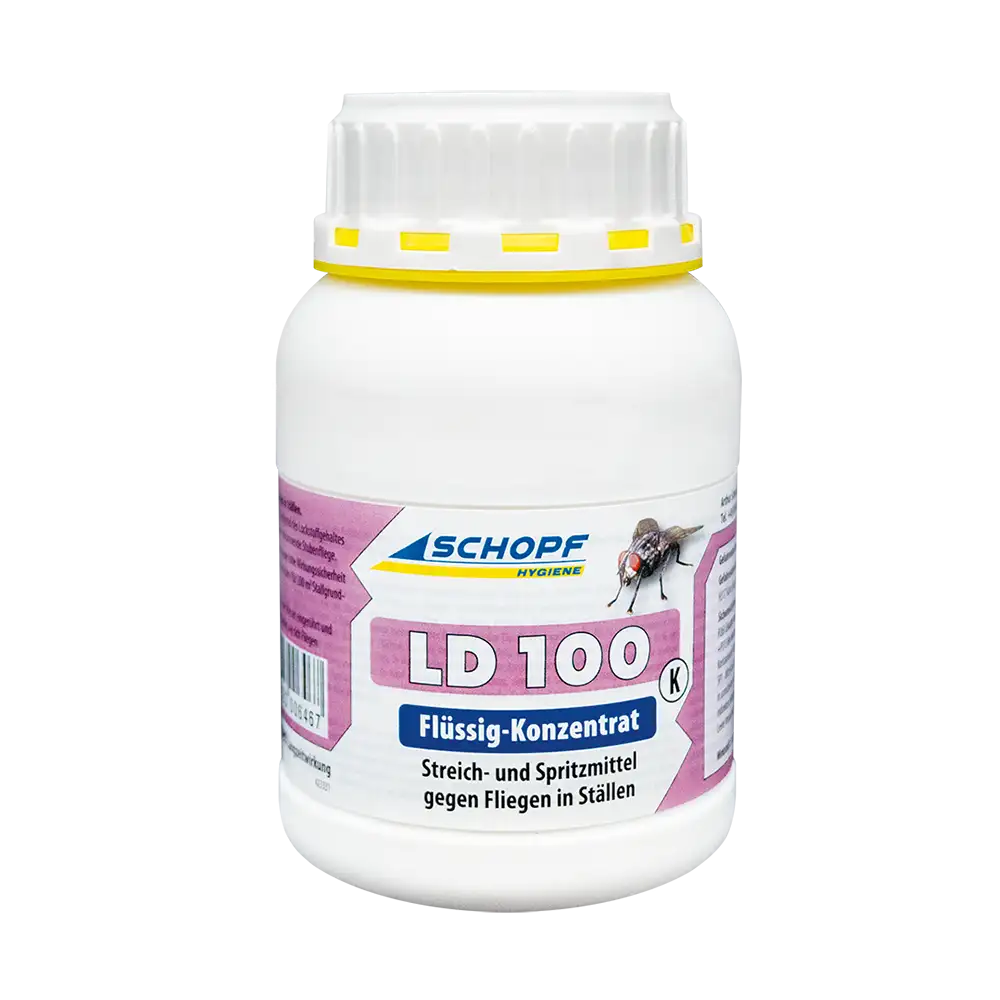
- Liquid concentrate for the control of flies (house fly Musca domestica) and calf flies (Stomoxys calcitrans)
- Application to cardboard for feeding and contact effect; attractive attractant ensures rapid uptake
- For use in indoor areas of animal houses (not for poultry); for professional users only
- Mixing: 1 part LD 100 K + 2 parts water; application with hand or backpack sprayer (≤ 3 bar)
Mode of action
LD 100 K is a spray agent for controlling flies in stables. The diluted solution is applied with a hand or backpack sprayer to cardboard which is attached to the flies’ preferred resting places. Due to the attractant it contains, the product has both a feeding and contact effect and achieves a good immediate and long-term effect.
Instructions for proper use
LD 100 K is approved as an insecticide against adult flies (house flies and damsel flies). The area of application includes indoor areas of cattle, calf, pig, piglet, horse and sheep stables; do not use in poultry stables. Treatment should be started when the first flies appear and, if possible, spread evenly over many small areas in the barn.
User category and application method
User category: For professional users.
Application method: Spraying. A hand or backpack sprayer with a manually operated low pressure device (3 bar or less) must be used.
Mixing, loading and dosing
Mixing ratio: 1 volume of LD 100 K plus 2 volumes of water.
Example: For a stable/barn with a floor area of 200 m², dilute 500 ml LD 100 K with 1 L of water and spread over 30-60 boards. The total area treated should not exceed 10 % of the barn size.
Application quantity and frequency
Dilution: 1 part LD 100 K + 2 parts water (e.g. 500 ml LD 100 K + 1 L water). Apply during the fly season (spring and beginning of summer). A maximum of three times a year, if necessary; the interval between two applications must be at least 30 days.
Instructions and safety measures
- A manually operated low-pressure device (≤ 3 bar) must be used for the spray application.
- Only prepare as much solution as is required for the application.
- Do not store the diluted solution; use the aqueous solution on the day of mixing.
- Do not use the product directly on building surfaces (e.g. walls).
- Do not apply the product directly to fertilizer/slurry.
- Do not use in areas that will be cleaned or hosed down afterwards.
- Wear disposable protective clothing (e.g. protective gloves and protective suit) when mixing, filling the equipment and applying the product in order to prevent contaminated clothing from being washed into the sewage system.
- The area where the product is mixed and applied to the boards must be covered with a disposable plastic film to prevent contamination of adjacent surfaces.
- During application, the cardboard lies horizontally on a surface covered with foil.
- Contaminated tools may only be reused after use without cleaning (if possible) and must be disposed of safely in accordance with national regulations (no waste water discharge).
- Product, product residues and product sludge must not be allowed to enter soil, drains, watercourses or sewers.
- Dispose of contaminated plastics and disposable clothing after treatment in the residual waste in accordance with the specifications of the local waste disposal company (incineration).
Safe handling of treated cardboard
- The product may only be applied to non-absorbent cardboard.
- After application, persons (including children and adolescents) and animals, with the exception of the farm animals to be treated, must not come into direct contact with the cardboard.
- Do not enter the barn during application; after hanging, only re-enter after a ventilation period of 5-15 minutes.
- The treated cardboard must be visibly labeled.
- Remove treated cardboard before cleaning and/or disinfecting the barn.
- After treatment, dispose of contaminated cardboard in residual waste (incineration) in accordance with local regulations; store in containers that are inaccessible to the general public and non-target animals.
Risk mitigation and other recommendations
- Do not apply near food, drink or on surfaces/utensils that come into contact with food, drink or animals.
- Place treated cardboard blanks out of reach of the public, pets, livestock and other non-target animals.
- Spray in downward direction only.
- When applying, leave one edge area of the cardboard untreated and only touch the untreated area when attaching/removing.
- Wear chemical-resistant protective gloves when handling; at least one suitable chemical protective suit type 6 (EN 13034). Waterproof footwear is recommended.
Measures for resistance management
If resistance occurs, recommend switching to a product with a different mode of action. To avoid resistance, alternate products with different modes of action; avoid frequent, repeated application of the same active ingredient. In the case of heavy infestations, application alone may be insufficient; it is advisable to apply a larvicide at the start of the season. Products can be combined with hygiene measures (e.g. frequent removal of manure) or non-chemical methods (e.g. parasitoids) as part of an integrated control program. Use monitoring methods (e.g. adhesive strips) before chemical treatment. Only use products in accordance with the recommendations on the label.
Notes
User protection: Wear protective gloves and protective clothing when handling.
Storage
Do not store near food, drink or animal feed. Keep container tightly closed, dry, cool, dark and ventilated. Shelf life: 24 months.
Liability
For application results that depend on weather-related or application-specific circumstances, liability is only assumed for the consistent quality of the product.