Effective and cost-effective
Effective control of stable flies
Information on fly control
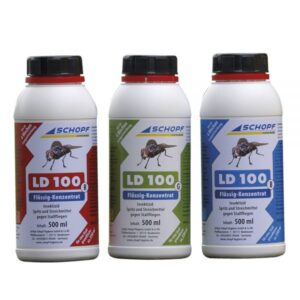
- Watering and spreading agent against fly maggots
- Fast onset of action after ingestion
- Alternating spraying with different active ingredients to avoid resistance
- Spraying and coating agents against flies
- For deep litter and slurry channel
- Effective against all types of insect larvae including rat tail larvae
Systematic fly and fly larvae control
Fortpflanzung
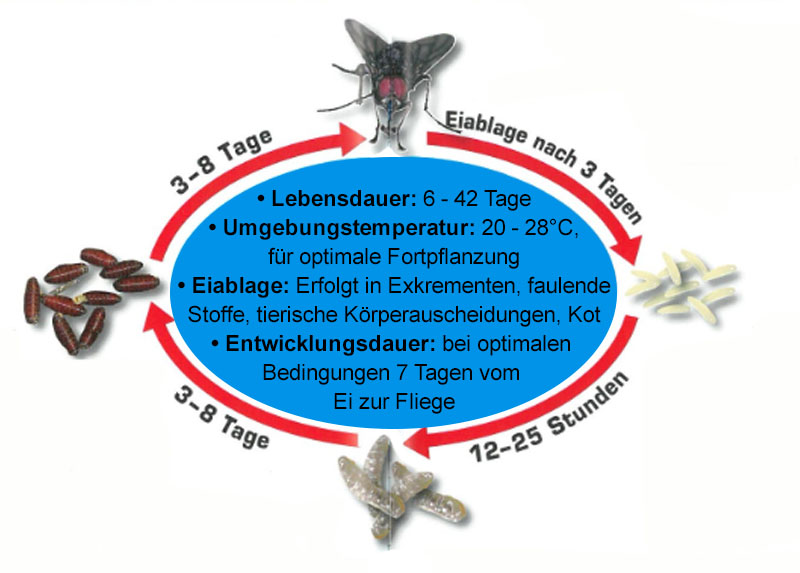
Schon 3 Tage nach Schlupf paaren sich die Fliegen und die Weibchen sind zur ersten Eiablage bereit. Die Entwicklung vom Ei zur Fliege kann bei guten Umweltbedingungen in 7 Tagen abgeschlossen sein. Unter optimalen Bedingungen sind bis zu 15 Generationen pro Jahr möglich.
Eiablage
Ein Weibchen legt mehrmals zwischen 150 und 400 Eier pro Eiablage in einem Intervall von 3–4 Tagen in zersetzendes organisches Material ab. Insgesamt legt eine Fliege im Leben etwa 2.000 Eier.
Puppe
Die Maden durchlaufen eine genetische Veränderung. Die Haut verhärtet, die Larven entwickeln sich zu Tönnchenpuppen. Nach vollendeter Entwicklung verlässt die Fliege die Puppenhülle durch eine Öffnung am Kopfende.
Larvenstadium
Die Larven benötigen etwa 12–25 Stunden bis zum Schlupf. Sie bewegen sich mit Körperkrümmung fort und ernähren sich vom Substrat, aus dem sie geschlüpft sind. Unter optimalen Bedingungen wächst eine Made in wenigen Tagen auf 12 mm.
Fly control - only 15% of the fly population are adults
Application in stables
1st application (1 - 4 weeks)
If a population of flies develops due to an influx and untreated areas, start applying an adulticide.
2nd application (4 - 6 weeks)
If the effect diminishes or the fly population increases, carry out a further application with an adulticide.
3rd application (4 - 6 weeks)
Carry out further applications as required.
Larvae control - 85% of the problem lies in manure and slurry
Use with manure and slurry
1st application (2 weeks)
Start applying a larvicide early, before a population develops in spring.
2nd application (3 - 4 weeks)
Repeat the application 2 weeks after the initial treatment to achieve a resounding effect.
3rd application (3 - 4 weeks)
Continue to treat continuously at intervals of 3-4 weeks to prevent a new population from developing.
FURTHER APPLICATION
Continue treatment as only the larvae can be controlled. Larvae that have already pupated can no longer be controlled and develop into flies.