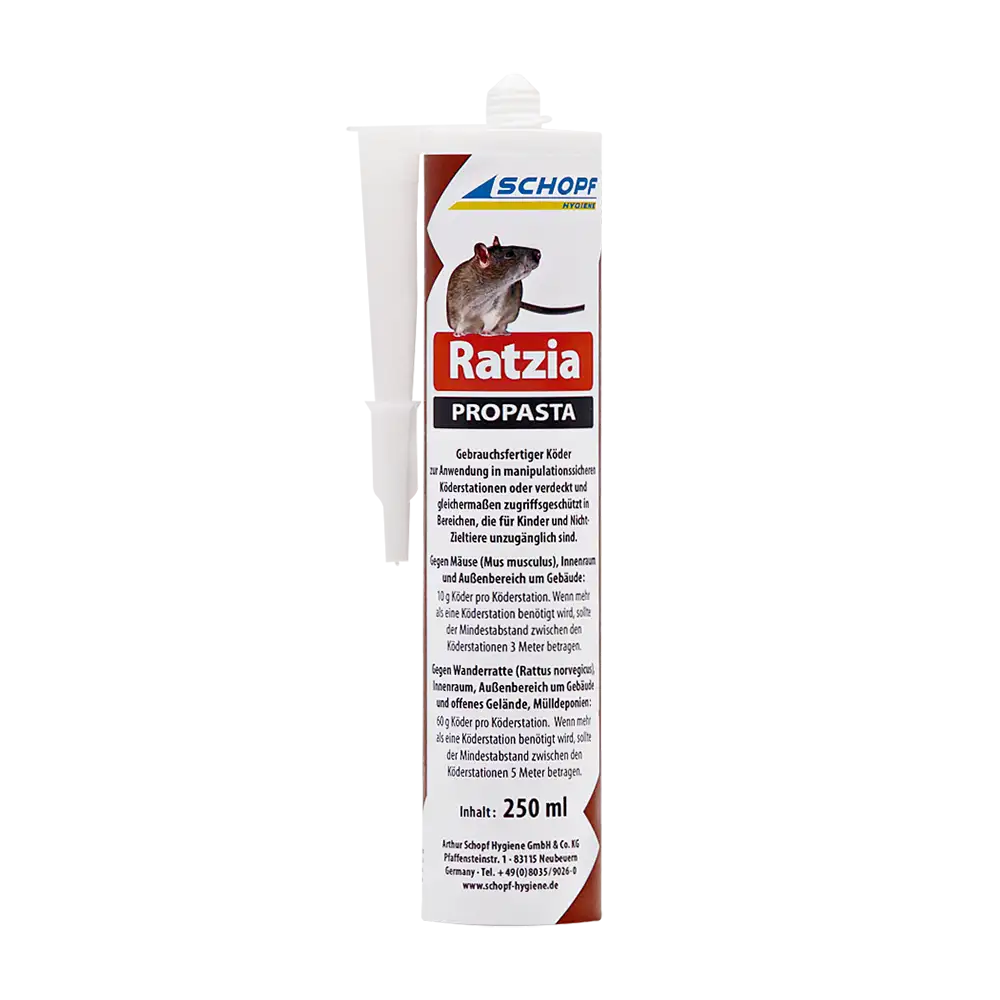
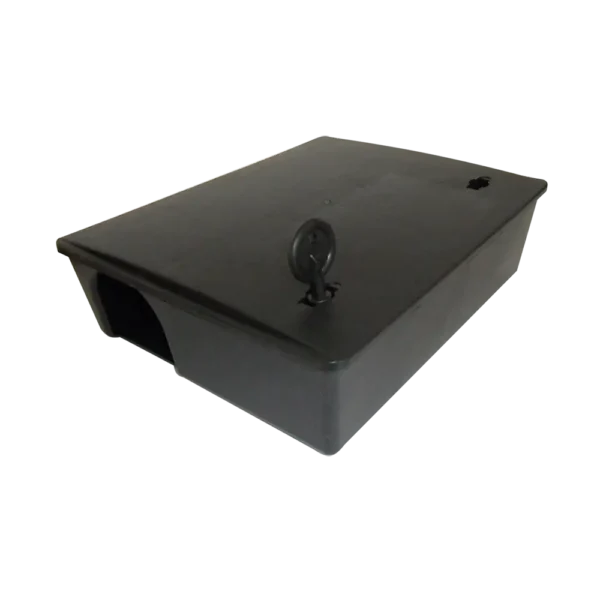
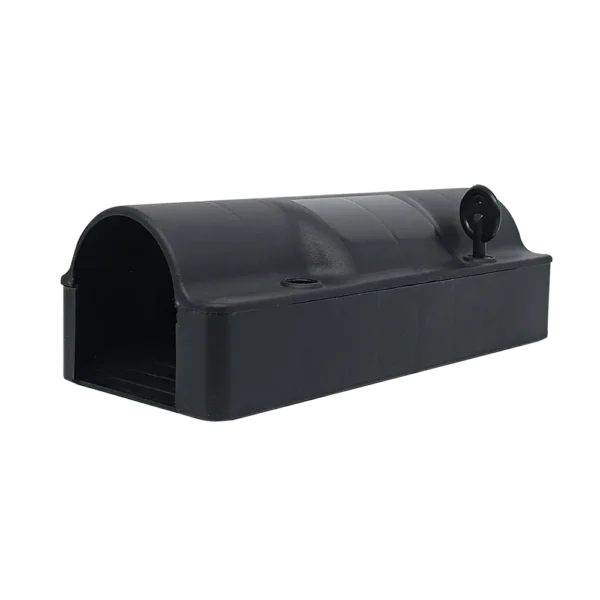
- Ready-to-use rodenticide bait, suitable for tamper-proof bait stations or concealed, access-protected locations
- Effective against house mice (Mus musculus) and Norway rats (Rattus norvegicus)
- Dosage: Mice 10 g per bait station, rats 60 g per bait station; observe minimum distance between stations
- Only for trained professional users; extensive documentation and labeling requirements
Product description
Ratzia® Propasta is a ready-to-use bait for the control of mice and rats. The bait must be used in such a way that children, pets, birds and other non-target animals have no access (tamper-proof bait stations or concealed, inaccessible places).
Target organisms and dosage
- House mice (Mus musculus) – indoor and outdoor areas around buildings: 10 g bait per bait station. Minimum distance of 3 m if there are several stations.
- Norway rat (Rattus norvegicus) – indoor areas, outdoor areas around buildings, open areas, garbage dumps: 60 g bait per bait station. Minimum distance of 5 m if there are several stations.
Application-specific notes
For trained professional users only. Read and follow all product information before use. Determine rodent species, locations and extent of infestation before baiting. Determine the extent, type and scope of documentation in consultation with the client; in food-relevant businesses, baiting plans and visit-specific inspection reports are required as a minimum. Keep documentation for at least 5 years.
Implementation of the fight
The aim is to eradicate the rodent population in the infested area. Removing easily accessible food sources and drinking troughs improves effectiveness. Do not clean up infested areas at the beginning, as this can make bait acceptance more difficult. The product is part of an integrated pest control system together with hygiene measures and, if necessary, physical methods.
Positioning and securing the bait stations
- If possible, attach bait stations to the ground or to structures and use them in a mechanically stable and tamper-proof manner.
- Set up stations so that they are inaccessible to non-target animals and clearly labeled (indication of rodenticide, product name, active ingredient(s), emergency call information).
- Bait should be secured so that it cannot be removed from the station.
Information and documentation
The client must be informed about ongoing measures; if necessary, he must inform his own employees and external service providers and affix additional warning notices. The contractor shall provide the client with information material on risks (primary and secondary poisoning), first aid measures, what to do in the event of spillage, measures to be taken if dead rodents are found, product and active ingredient names including concentration as well as contact details of the user and a poison control center. Document the date the bait was placed.
Handling, control and monitoring
Wear chemical-resistant protective gloves when handling; do not eat, drink or smoke. Wash hands and exposed skin after use. Replace eaten bait at each inspection and document acceptance. If bait intake is low, check location or formulation. If bait consumption continues after 35 days without a decrease in activity, check for possible resistance and consider other mechanisms of action or traps if necessary.
Cleaning and handling accessories
The authorization holder provides precise information on the cleaning of accessories (e.g. bait stations) and the collection of bait residues; low exposure methods must be used. Do not open sachets containing the bait!
Special areas of application and intervals
House mice and rats – indoors
Once baiting is complete, remove all bait and dispose of it in accordance with local regulations. Permanent baiting (permanent baiting independent of infestation) is only permitted in narrowly defined exceptional cases and only by expert users; requirements must be checked and documented in writing. In the case of permanent baiting independent of infestation, control intervals and supervision must be defined in accordance with the risk analysis.
House mice and rats – outdoor areas around buildings
Protect the bait from the weather and place it in areas that cannot be flooded. Replace soiled or water-damaged bait. Once baiting is complete, remove the bait and dispose of it in accordance with regulations.
Rats – Open terrain and landfills
Protect bait from the weather, place in non-floodable areas and replace if soiled. If placed directly in soil, cover entrances and place bait deep; do not use in rain. Collect spilled bait, residues and dead rodents and dispose of according to local requirements.
Rats – Sewer system
Apply bait in such a way that it does not come into contact with water or is washed away. First check after 14 days, then every 2-3 weeks. Once baiting is complete, remove bait and dispose of in accordance with regulations.
Inspection intervals for professional users with advanced competence
Initially check at least after the 5th day and then weekly; also applies to measures lasting longer than 35 days. During inspections, search affected areas for dead rodents and dispose of them properly. Bait stations must be used; tamper-proof stations can only be dispensed with in areas inaccessible to children and non-target animals.
Risks and labeling
This product contains an anticoagulant. Symptoms of poisoning may include nosebleeds, bleeding gums, bruising and blood in the stool or urine; symptoms may be delayed (4-10 days after ingestion). Antidote: Vitamin K1 (can only be administered by medical/veterinary professionals).
Bait stations must carry information such as “do not move or open”, “contains a rodenticide”, product name, active ingredient(s) and details of the poison control center. The product is dangerous for wild animals.
Risk mitigation measures and other information
The product may only be supplied to competent professional users who have the necessary training certificates, provided that expertise is required. Trained professional users (with appropriate expertise or certificate) may also use the product. The contents of the required training courses include the biology and behavior of rodents, legal principles, integrated pest control, the mode of action of rodenticides, risk reduction, application techniques and documentation.
Important: Products with the active ingredients brodifacoum, difethialone and flocoumafen must not be used for permanent baiting. Products with the active ingredients difenacoum and bromadiolone must not be used for pulse baiting. Do not use the products for longer than 35 days without checking the infestation situation and effectiveness. If resistance is suspected, other mechanisms of action or more potent anticoagulants should be tested.
Further information
Due to the delayed effectiveness of anticoagulant rodenticides, effects usually occur 4-10 days after ingestion. Rodents can transmit diseases; do not touch dead rodents with bare hands – use suitable protective gloves or tools (e.g. tongs). This product contains a bittering agent and a colorant.